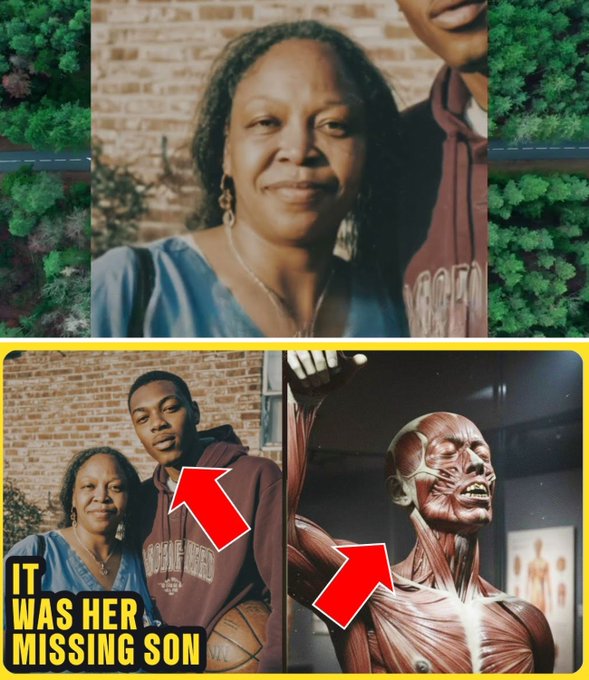
Marcus Mitchell Missing (1999) UPDATE: Atlanta, GA Mother Diana Mitchell Identifies Son’s Remains in Science Exhibition After 25-Year Search
Case Summary
The Marcus Mitchell missing case (1999) in Atlanta has taken a dramatic turn after 25 years. In 2024, Diana Mitchell, the mother of the missing 19-year-old college student, identified what she believed to be her son’s preserved remains displayed in a public anatomy exhibition held at the Georgia World Congress Center.
Following renewed investigation, court-approved DNA testing ultimately confirmed that the specimen exhibited as an anonymous human body was indeed Marcus Mitchell, who disappeared under unexplained circumstances in 1999. The discovery has reignited public debate about missing persons investigations, anatomical specimen sourcing, and oversight within the body exhibition industry.
Background: Disappearance of Marcus Mitchell in 1999
Marcus Mitchell was a 19-year-old freshman living in Atlanta when he was reported missing in 1999. According to initial reports filed with the Atlanta Police Department, Marcus disappeared after leaving campus one evening.
Authorities initially suggested the possibility that the teenager had voluntarily left home. However, his mother, Diana Mitchell, consistently rejected that theory, stating that Marcus maintained close contact with his family and had shown no signs of intending to run away.
At the time of his disappearance, Marcus’s vehicle was reportedly located abandoned near a local hospital facility in Atlanta. Despite search efforts and standard investigative procedures, no confirmed sightings or physical evidence emerged that could clarify his fate.
Over the years, the case gradually went cold.
A Mother’s 25-Year Search
For more than two decades, Diana Mitchell continued searching for answers. Family members reported that she preserved Marcus’s bedroom exactly as it had been the day he disappeared, believing he might one day return.
During those years, Diana reportedly:
- Distributed missing person flyers across Georgia
- Contacted investigative agencies and advocacy groups
- Hired private investigators
- Maintained communication with law enforcement
- Organized community awareness efforts
Her persistence became a defining feature of the case, which quietly remained unresolved for 25 years.
2024 Discovery at an Atlanta Anatomy Exhibition
In 2024, Diana attended a public anatomical science exhibition at the Georgia World Congress Center with her granddaughter Jasmine. Jasmine is Marcus Mitchell’s daughter, born after his disappearance.
The exhibition displayed preserved human bodies presented for educational and scientific purposes. According to accounts from the family, Diana became concerned when she noticed a particular anatomical display posed in a basketball-style jump.
Several distinctive features reportedly drew her attention:
- Surgical pins in the ankle
- Evidence of a healed leg fracture
- A rare spinal abnormality
- A gold dental crown
Diana stated that these characteristics matched medical details known about her missing son.
Request for Identification and Legal Action
Diana approached exhibition staff seeking further information about the specimen’s identity. Organizers responded that the bodies displayed in the exhibition came from legally obtained anatomical donations and were anonymized to protect donor privacy.
When no identifying details were provided, Diana began pursuing legal action.
A petition was filed requesting:
- Temporary closure of the exhibit section
- Permission for DNA testing of the remains
- Disclosure of sourcing documentation
The first request was denied due to insufficient supporting evidence linking the specimen to the missing person case.
Private Investigation and Supply Chain Tracing
Determined to obtain proof, Diana hired private investigator Raymond Torres to examine the origin of the anatomical specimen.
Torres began tracing the supply chain of preserved human remains used in educational exhibitions. His research reportedly identified a company known to have worked with medical facilities that handled unclaimed bodies during the late 1990s.
Records indicated that one of those facilities had connections to the same hospital where Marcus Mitchell’s car had been found abandoned in 1999.
These findings generated renewed public attention and prompted authorities to reconsider the long-dormant case.
Atlanta Police Reopen the Marcus Mitchell Case
Amid growing media coverage and community concern, the Atlanta Police Department officially reopened the Marcus Mitchell missing person investigation.
A second legal petition was filed, this time including the new investigative findings. The court approved the request for DNA testing of the anatomical specimen.
Forensic specialists compared DNA samples taken from the specimen with family reference samples.
The results confirmed a match with extremely high certainty.
Confirmation and Return of Remains
The testing verified that the preserved body displayed in the exhibition was Marcus Mitchell.
After 25 years of uncertainty, the Mitchell family finally received confirmation of his fate.
Following legal procedures and coordination with authorities, Marcus’s remains were released to the family and returned for burial. Community members, local advocates, and supporters attended memorial services honoring his life.
Ongoing Questions and Industry Scrutiny
The case has raised significant questions regarding the sourcing and documentation of human remains used in anatomical displays.
Experts and advocacy groups have called for:
- Greater transparency in body donation verification
- Stricter tracking of unclaimed remains
- Improved oversight of educational body exhibitions
While investigations into the chain of custody remain ongoing, the discovery brought long-awaited closure to a mother who spent 25 years searching for her missing son.
Legacy of the Marcus Mitchell Case
The Marcus Mitchell missing case (Atlanta, 1999) stands as a powerful example of persistence in long-term missing person investigations. Diana Mitchell’s determination ultimately led to the identification of her son decades after his disappearance.
For the Mitchell family, the confirmation ended years of uncertainty and allowed Marcus to be laid to rest with dignity.
For investigators and policymakers, the case highlights the importance of transparency, accountability, and continued advocacy in unresolved missing person cases.